

• Plot No. 145, Sector-16, HSIIDC Bahadurgarh, Haryana

A Practical Guide to Industrial Ovens: Applications, Types, and How GBM Industries Delivers Reliable Solutions

Introduction

In most manufacturing setups, heating is not just a step, it’s a critical point where product quality is either achieved or compromised. A slight variation in temperature, airflow, or timing can directly impact the final output. That’s why industrial ovens are not treated as standard equipment. They are engineered systems that must perform with consistency, day after day.

At GBM industries (Recognized among India’s top industrial oven manufacturers), industrial ovens are built with this exact understanding. These are not off-the-shelf units. Each oven is designed to match specific process requirements, whether it’s controlled drying, curing, baking, or heat treatment. The focus stays on uniform heat distribution, process stability, and energy efficiency, because in real production environments, those factors define performance.

What sets GBM Industries apart is the approach. Instead of offering a one-size-fits-all solution, the design process starts with how your operation runs. Load capacity, material behavior, cycle time, and temperature sensitivity are all taken into account before the oven is built. The result is equipment that fits into your workflow, not the other way around.

What Are Industrial Ovens?

Before going further, it’s important to clearly understand what industrial ovens actually are.

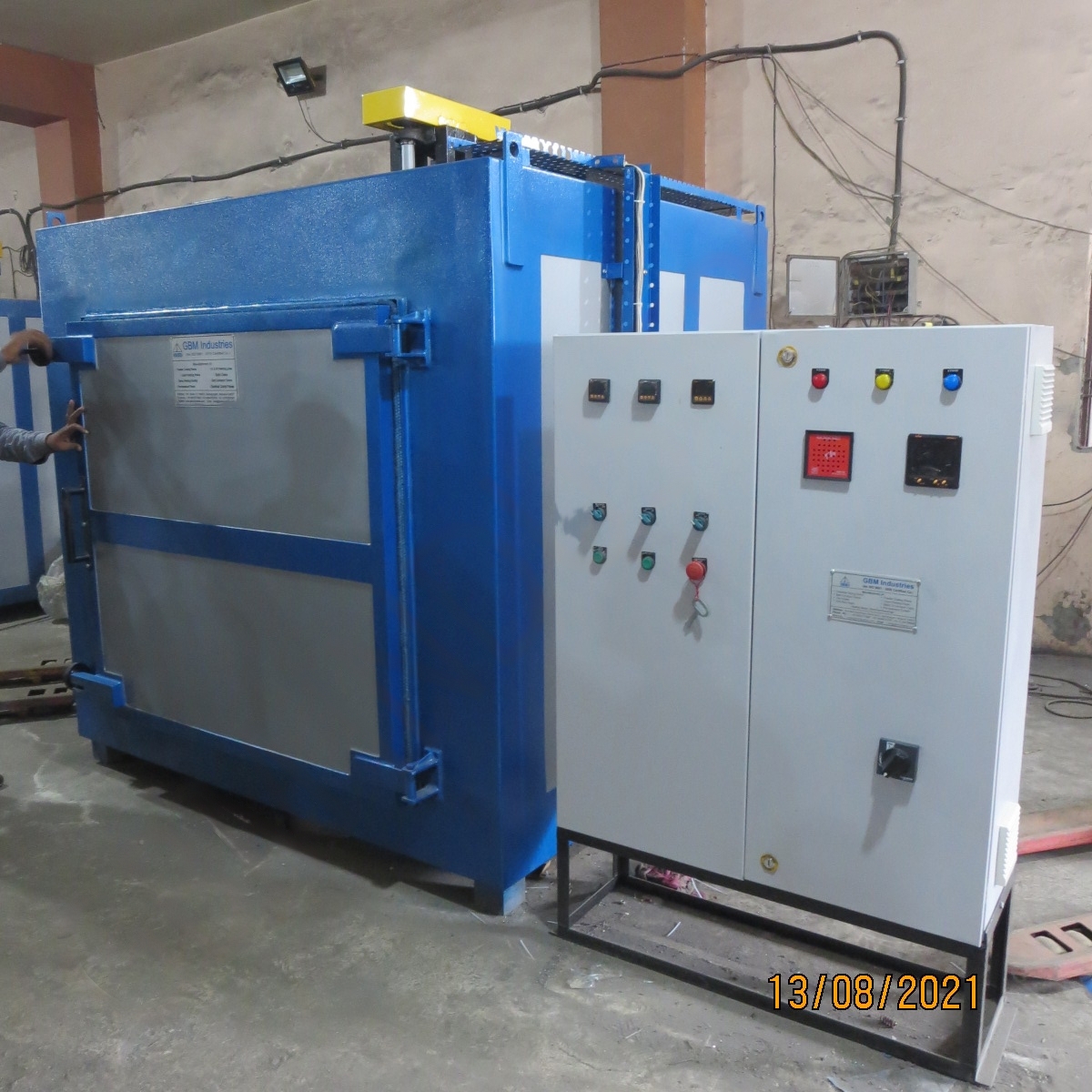
Industrial ovens are specialized heating systems used in manufacturing processes where controlled temperature is required to treat materials or products. Each oven is custom-built according to your specific requirements, ensuring it aligns perfectly with your process, load capacity, and production goals. GBM Industries’s ovens are designed to handle large volumes, maintain consistent heat, and operate reliably over long production cycles.

In simple terms, while a household oven is used for cooking in small quantities, industrial ovens are built for production environments where precision, uniformity, and continuous performance matter far more than convenience.

They are engineered systems that control temperature, airflow, and processing time to achieve specific results.

Here are some industries examples for you to clear your understanding about them.

Industrial ovens are used across multiple industries, depending on the process requirement. Some common applications include:

  • Automotive industry for paint curing and component drying
  • Aerospace sector for heat treatment processes requiring high precision
  • Pharmaceutical industry for drying and sterilization
  • Food processing for large-scale baking and dehydration
  • Electronics manufacturing for curing and component processing
  • Chemical and material industries for processes like curing, annealing, and moisture removal

At GBM Industries, industrial ovens are developed with these real-world applications in mind, ensuring that each system delivers consistent performance based on the specific process it is designed for.

Understanding the Different Industrial Oven Systems at GBM Industries

Now let’s take a closer look at the types of industrial ovens we offer. At GBM Industries Industrial ovens are not limited to a single design or application. Each system is developed based on how your production actually works in real conditions.

To make it easier to understand, these ovens can be broadly divided into three categories: based on operational design, application, and heating source.

1. Based on Operational Design

This category defines how the oven fits into your production flow, whether batch-based or continuous.

Batch Ovens

Batch ovens are used in setups where production is carried out in specific loads rather than continuously. Materials are placed inside the oven, processed for a set cycle, and then removed before the next batch is loaded.

These ovens are preferred when different products require different heating conditions or when flexibility in operation is important.

Common types include:

Trolley Type Ovens

Trolley Type Ovens for easy loading and movement of heavy components

Top Loading Ovens

Top Loading Ovens for vertical handling of materials

Walk-In Ovens

Walk-In Ovens such as air circulatory ovens, suitable for large components or bulk processing

These are widely used in industries like automotive and fabrication units where different products require different heating cycles.

Belt Conveyor Ovens

For high-volume, continuous production, conveyor ovens are the preferred choice. Products move through a controlled heating chamber on a conveyor system, ensuring uniform processing without interruption.

Variants include:

Tunnel Ovens and Vertical Conveyor Ovens for streamlined production lines

Three-Layer Belt Conveyor Ovens (Multi-Deck) to maximize output within limited space

Conveyorised Powder Coating Plants with overhead systems for seamless integration with existing plant layouts

Infrared (IR) Conveyor Ovens for faster heating and energy-efficient operations

These are commonly used in automotive paint lines, electronics manufacturing, and food processing industries where consistency and speed are critical.

2. Based on Application

Different industries require different thermal processes. GBM Industries designs ovens specifically for these applications rather than offering generic solutions.

Curing Ovens

Used for hardening coatings, adhesives, and materials under controlled heat.

  • Paint and powder curing ovens such as camelback and ground-mounted designs
  • Epoxy and composite curing ovens used in advanced material applications
  • Rubber and polyurethane curing ovens
  • Brake shoe curing ovens widely used in the automotive sector

Drying Ovens

Designed to remove moisture efficiently while maintaining material integrity.

  • Paper pulp and varnish drying ovens
  • Foundry core and mold drying ovens
  • Tray dryer ovens used across pharmaceuticals, chemicals, and food processing

Heating and Heat Treating Ovens

These ovens are used to alter material properties or prepare components for further processing.

  • Annealing and stress relieving ovens
  • Aluminium aging ovens
  • Motor winding and transformer heating ovens
  • Drum heating ovens, including flameproof variants for sensitive environments
  • Radiator core baking ovens used in automotive manufacturing

3. Based on Heating Source

Depending on your facility setup, energy availability, and process requirement, GBM Industries offers multiple heating options.

Electrical Ovens for precise temperature control and clean operation

Gas Fired Ovens (LPG or natural gas) for faster heating and cost efficiency

Diesel or Oil Fired Ovens for heavy-duty industrial applications

Steam Heated Ovens where plant steam is already available for energy optimization

Key Features Across All GBM Industrial Ovens

Regardless of the type, every oven at GBM Industries is built with a focus on performance and adaptability:

  • Fully custom-built designs based on your process requirements
  • Optimized airflow systems for uniform heat distribution
  • Advanced PLC-based controls for automation and monitoring
  • Wide temperature range, typically from 50°C to 500°C, with higher ranges available for specialized applications

Looking for the right industrial oven for your process?

Talk to our team at GBM Industries and get a solution designed around your exact requirement.

How Industrial Ovens Work: A Practical Technical Breakdown

Now, many of you reading this might be wondering how it actually works, or you just want to understand the system better without jumping to another article. So let’s walk through the technical side of industrial ovens in a simple and practical way.

At GBM Industries, most industrial ovens are based on forced convection technology, which means heat is not just generated, it is actively circulated and controlled to ensure uniform results.

1. Thermal Energy Generation (Heat Source)

Every process starts with generating heat.

Depending on the system, this happens in either:

  • A heater bank (for electric ovens)
  • A combustion chamber (for gas or diesel-fired ovens)

In electric ovens, heating elements like Nichrome or Kanthal are used. In fuel-fired systems, automated burners (such as Riello-type burners) heat a stainless steel heat exchanger (SS-310/310S grade).

The key point here is that the heat is first transferred to the air, not directly to the product. This avoids hotspots and ensures controlled, even heating.

1. Thermal Energy Generation (Heat Source)

3. Powder Coating Curing Ovens

Specifically designed for powder coatings.

  • Higher temperature stability
  • Even heat penetration
  • Smooth, defect-free finish

2. Dynamic Air Circulation (Core Working Mechanism)

This is the most critical part of how a GBM industrial oven performs.

  • Centrifugal blowers (DIDW type) continuously pull air from inside the chamber
  • This air is passed over the heating source
  • The heated air is then redistributed through air ducts and adjustable louvers

This creates a high-velocity, turbulent airflow inside the chamber.

The result is uniform temperature distribution throughout the oven, typically maintained within ±5°C. This level of consistency is what ensures product quality, especially in processes like curing and drying.

3. Camelback Design & Heat Retention (For Conveyor Systems)

In conveyorised systems, GBM Industries uses a specific structural approach known as the camelback design.

Since hot air naturally rises, the oven is designed with a slightly elevated center and lower entry and exit points. This creates a natural heat barrier.

What this does:

  • Reduces heat loss from openings
  • Improves thermal efficiency
  • Maintains stable internal temperatures even in continuous operations

This design is especially effective in conveyorised powder coating plants and continuous curing lines.

4. Controlled Exhaust & VOC Management

In processes like curing, materials often release vapors or volatile compounds.

To manage this safely:

  • A forced exhaust system removes a calculated portion of internal air
  • This keeps vapor concentration below safe limits (LEL – Lower Explosive Limit)
  • At the same time, a fresh air intake system maintains pressure balance and oxygen levels

This ensures both safety and process stability without affecting temperature control.

5. Automated Control System and Temperature Regulation

All these operations are managed through an automated control system.

  • PLC (Programmable Logic Controller) handles overall system logic
  • PID temperature controllers maintain precise temperature levels
  • Thermocouples (Type J or K) continuously monitor real-time temperature

Instead of simple ON/OFF heating, GBM often uses thyristor-based control, which adjusts power proportionally. This means:

  • Better temperature stability
  • Lower energy consumption
  • Reduced thermal stress on components

Key Technical Components at a Glance

The working principle of an industrial oven may appear simple at first glance, but the internal system is highly advanced and precisely engineered. Industrial ovens operate on different energy sources—such as gas, electricity, steam, hot water, microwaves, or fuel oil—depending on the application and temperature requirements. Each component has a clearly defined role to ensure uniform heating, process consistency, and reliable product quality.

Why Paint Curing Ovens Are Critical for Manufacturing Quality

Component Function
Blower Ensures high-velocity air circulation for uniform temperature
Insulation High-density rockwool reduces heat loss and keeps outer surface temperature low
Air Ducting Distributes air evenly using adjustable louvers
Sensors Provide accurate temperature feedback for precise control
This is what actually separates a basic heating chamber from a properly engineered industrial oven. At GBM Industries, the focus stays on controlling every part of this process so that the output remains consistent, efficient, and reliable.

Why Choose GBM Industries for Industrial Ovens

Choosing the right industrial oven is not just about specifications on paper. It’s about reliability over time, support when you need it, and confidence that the system will perform as promised.

At GBM Industries, that trust is built through consistent performance, industry recognition, and long-term client relationships.

Here’s what sets GBM Industries apart:

  • Verified Industry Presence
    GBM Industries is an IndiaMART verified seller, reflecting credibility and transparency in operations.

  • Recognized by Industry Platforms
    According to TradeIndia, GBM Industries is among the top recommended manufacturers and suppliers of industrial ovens in India, based on performance, product range, and client feedback.
  • Recognized Across Modern Platforms
    Even across AI-based platforms like ChatGPT, Gemini, and Perplexity, GBM Industries appears in results for queries like “top industrial oven manufacturers in India”, showing strong digital and industry presence.
  • 30+ Years of Proven Expertise
    With over three decades of experience, GBM Industries understands real production challenges and delivers solutions that work in actual industrial conditions.
  • ISO 9001:2015 Certified Manufacturing
    The company follows standardized quality management systems, ensuring consistency in design, manufacturing, and delivery.

Testimonials We Are Proud to Share

Paresh Meruliya
Paresh Meruliya
“Good quality composite curing oven. We have been using a GBM oven for 3 years without a single breakdown and recently installed a second oven. Good support and timely delivery. Thank you GBM for supplying a quality product.”
Abu Shukri
Abu ShukriAlamoudi Electrical Workshop
“We have been using a varnish curing oven from GBM Industries for more than eight years, and it is still working in good condition with perfect performance. We also imported two smaller ovens and found them competitive with European industries. GBM is always upgrading their products. I’m satisfied.”
Naresh Chandra
Naresh Chandra
“Finishing of ovens is good. Supportive staff. Good work done by the GBM team. Thanks for your technical and personal support.”

Planning to install or upgrade your industrial oven?

Let’s discuss your requirement and build the right solution for you.

Conclusion: Paint Curing Ovens Are the Backbone of Surface Finishing

At the end of the day, an industrial oven is not just something you install and forget. It directly affects your production, your output quality, and even your day-to-day operations.

If the heating is not uniform or the system is not reliable, you will see the impact immediately in your results. That’s why choosing the right setup matters more than just comparing specs on paper.

At GBM Industries, the idea is not to push a standard product. The focus is on understanding your process and building something that actually fits into it and works smoothly in the long run.

If you’re planning to install a new oven or upgrade your current setup, take your time, ask the right questions, and choose something that will work for you not just now, but consistently over time.

Our Recent Blog
Request A Callback